 n8n
n8n
n8n is bringing persistent customer context to multi-agent workflows through Amazon Bedrock AgentCore, reducing a familiar support failure: one AI agent handing a conversation to another, only for the customer to repeat everything.
In an official blog post, n8n outlines a support workflow in which a triage agent routes each request to one of three specialists. One performs calculations in a sandbox, another retrieves AWS guidance, and a third handles investigation. All four agents run through a single AgentCore harness and access memory associated with the same customer.
That architecture addresses a practical limitation of agent teams. Each specialist may be capable within its domain, but a handoff can break the conversational thread if the receiving agent starts without the original request or previous responses.
Shared Memory Across Specialist Agents
Amazon Bedrock AgentCore is AWS infrastructure for building, connecting and operating AI agents using different models and frameworks. Its AgentCore harness, which AWS describes as generally available, supplies the managed scaffolding around an agent loop.
Builders define the model, available tools, skills and instructions in configuration. AgentCore then assembles and runs the loop, while n8n provides the workflow layer used to receive requests, route work and connect the agents with other services.
The key component for this use case is AgentCore Managed Memory. Memory can be scoped using an actor and session. By using an Actor ID that represents the customer, rather than an individual agent, each specialist can access the same relevant history.
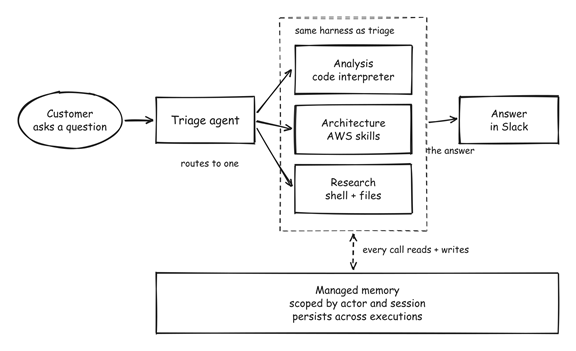
This offers an alternative to two common workarounds. A workflow can pass the full transcript into every handoff, but that approach becomes less practical as conversations approach a model’s context limit. Teams can also store and retrieve history through a vector database, although that introduces another database and embedding pipeline to operate.
AgentCore’s managed memory moves that responsibility into the agent infrastructure. The result is not simply a longer chat history. It lets multiple agents participate in what the customer experiences as one continuous interaction.
What Builders Can Do With It
Customer support is the clearest example, particularly when requests cross technical, billing or product domains. A triage agent can classify the issue, select a specialist and preserve the context that informed the decision. The specialist can then work from the customer’s earlier description instead of asking for the integration name, error or configuration details again.
The same pattern could apply to internal operations where requests move between research, analysis and execution agents. The implementation described by n8n is especially relevant to technical teams already using AWS and looking to coordinate specialized agents without maintaining a separate memory stack.
The release also extends n8n’s broader effort to make agents manageable as workflow components. It follows the company’s Agent Harness work, which makes AI agents first-class automation objects, and its expansion of OAuth connections across more than 70 MCP servers.
There are still design decisions for builders. Each agent needs a defined role, instructions and appropriate tools, while the routing layer must determine which specialist should receive a request. Customer identity also has to be mapped consistently to the Actor ID, since that is what allows the agents to share the correct memory.
n8n’s announcement does not specify separate pricing or plan requirements for the node. Teams evaluating it will also need to account for the AWS services and models used by their AgentCore configuration.
Frequently asked questions
What is n8n Amazon Bedrock AgentCore?
It is an n8n integration for building workflows around Amazon Bedrock AgentCore, AWS infrastructure for running and coordinating AI agents. The example published by n8n uses one triage agent and three specialists that share customer memory through a single AgentCore harness.
How does shared customer memory work?
AgentCore Managed Memory is scoped by actor and session. The workflow assigns an Actor ID to the customer, allowing different specialist agents to retrieve history associated with that person rather than maintaining isolated conversations.
What does n8n Amazon Bedrock AgentCore cost?
n8n’s announcement does not provide node-specific pricing or identify a required n8n plan. Users should separately review the costs of the AWS services, models and AgentCore resources used in their workflows.
Sources
1 checkedHow we cover tool news: Create With's tool desk drafts these reports with AI from the sources listed above and checks them against those sources before publishing.




 ElevenLabs
 Notion