 Voiceflow

Voiceflow announced on LinkedIn two features aimed at making AI agents less opaque and more capable: evaluation log visibility and variable persistence controls. The updates, released July 3rd, give developers finer control over what agents remember and more insight into how they reach decisions.
The platform already supports environment-based testing, but these new capabilities push observability and memory management further. Teams building voice and chat agents can now choose which customer data persists across sessions and score agent performance based on internal execution logs, not just conversation transcripts.
Evaluation Logs Expose Playbook, Workflow, and Tool Behavior
The new log visibility setting lets evaluation models see what an agent actually did behind the scenes. When scoring a transcript, teams can now include playbook logs (showing which playbooks fired and how they reasoned), workflow logs (tracing deterministic steps), and tool logs (inspecting every API call, input, and response).
Each log type is opt-in. Enable all three for maximum context, or disable them to reduce credit usage. The flexibility matters when evaluations run at scale. A team testing hundreds of transcripts might want full logs for a sample set, then lean logs for volume testing.
Voiceflow frames this as a context-versus-credit trade-off. More logs mean richer evaluation context but higher LLM token costs. Fewer logs keep evaluations cheaper but sacrifice insight into internal agent behavior. The granular controls let teams tune the balance per evaluation run.
Variable Persistence Gives Agents Selective Memory
The variable persistence feature addresses a common friction point: agents that either forget everything or remember too much. Voiceflow now lets developers specify, per variable, whether it persists across sessions.
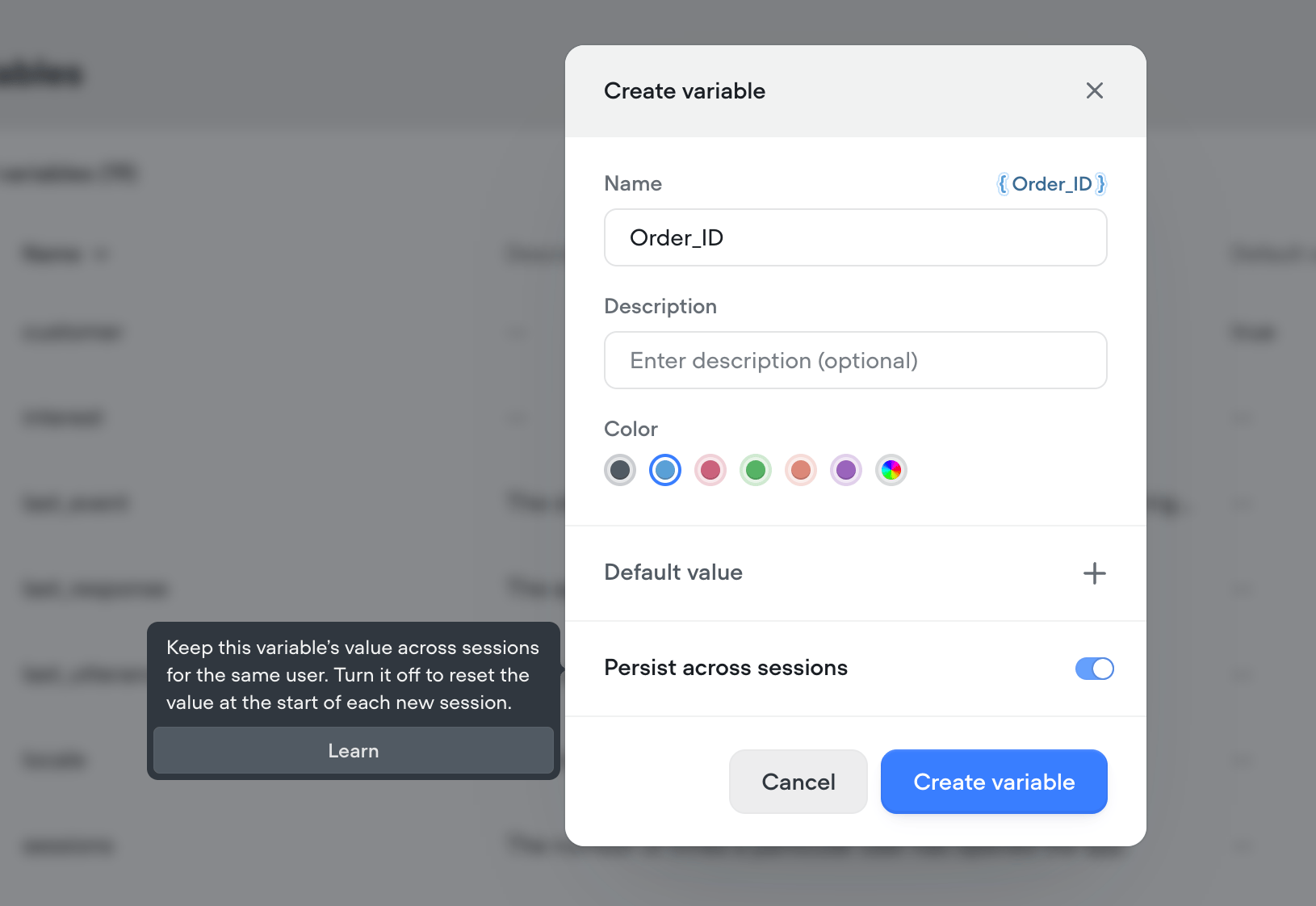
A support agent might persist customer name, account tier, and preferences, but reset one-time verification codes or temporary cart data. The control is binary: persist or reset. No middle ground for partial memory or time-based expiration, at least not yet.
This builds on Voiceflow's V4 Context Engine, which introduced structured memory management earlier this year. Variable persistence completes the picture by letting developers decide what sticks between sessions, not just within them.
The feature ships with no additional configuration required beyond toggling persistence per variable. Teams can retroactively enable persistence for existing variables without rebuilding workflows.
Observability as a Product Priority
These updates continue a pattern. Voiceflow has steadily added observability features over the past year: query rewriting for knowledge base search, traffic splitting for A/B testing, and now evaluation log visibility. The platform is positioning itself as a tool for production AI agent deployments, not just prototypes.
The log visibility feature in particular signals a focus on enterprise use cases. Evaluation with full execution logs is useful for teams running compliance checks, auditing agent behavior, or debugging edge cases at scale. Consumer chatbot builders likely care less about playbook reasoning logs than enterprises managing complex multi-step workflows.
Both features are available now to all Voiceflow users. The company has not announced pricing changes or usage limits tied to the new capabilities.
Sources
1 checkedHow we cover tool news: Create With's tool desk drafts these reports with AI from the sources listed above and checks them against those sources before publishing.




 ElevenLabs

 Glide

 Stripe