Supabase
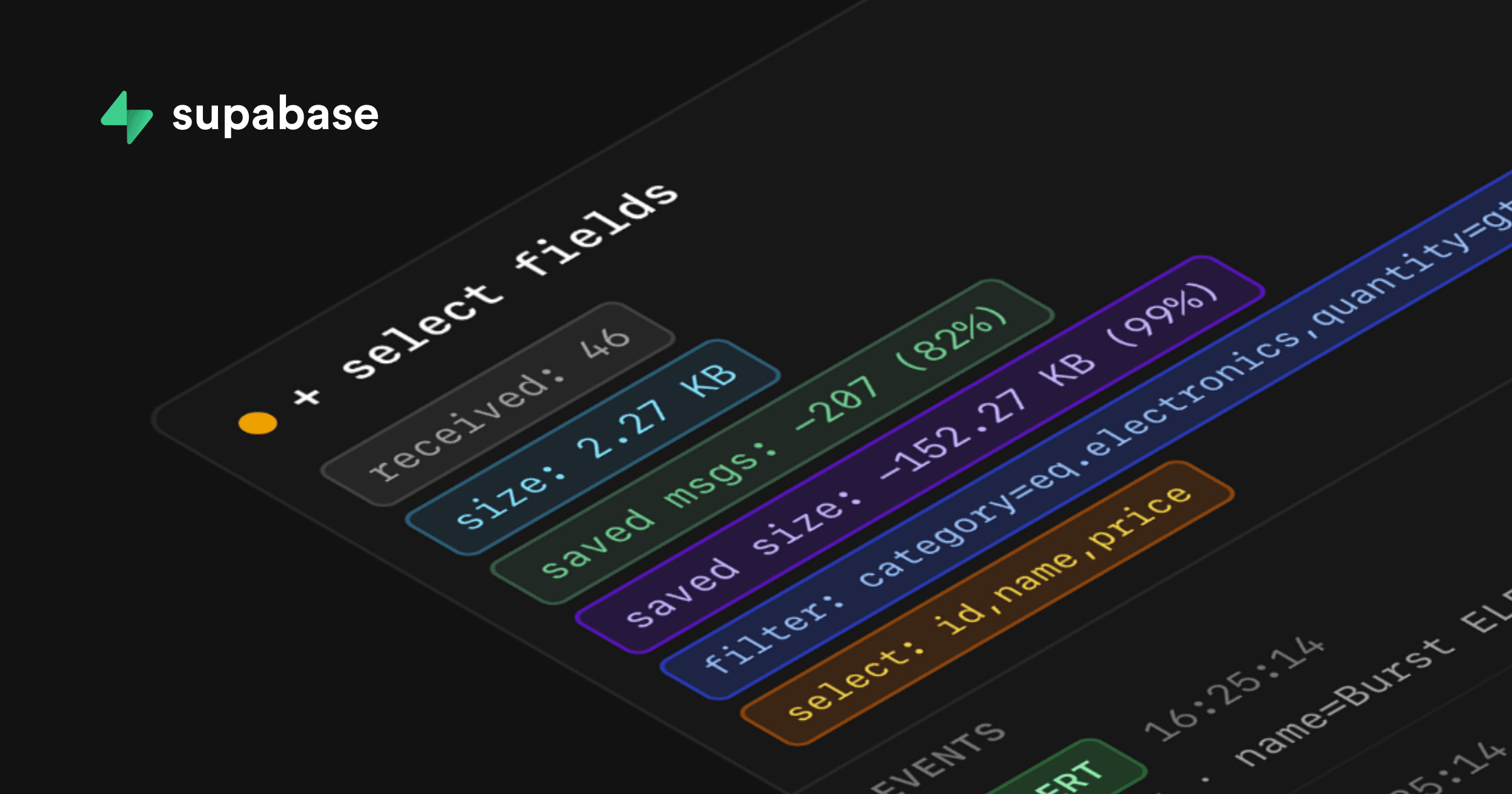
Supabase has made its realtime database subscriptions considerably more selective. Postgres Changes now supports multiple filters joined with AND, a broader set of operators, and opt-in column selection, giving developers more control over which events cross a WebSocket and what each payload contains.
The database platform announced the update on LinkedIn on August 5. The features are available now, although column selection requires @supabase/supabase-js version 2.109.0 or newer. The filtering improvements work with existing client versions.
Postgres Changes is Supabase’s mechanism for streaming row-level inserts, updates, and deletes to applications. It is commonly used to refresh dashboards, display notifications, synchronize interfaces, or trigger application logic without repeatedly querying the database.
Multiple Conditions on One Subscription
Previously, a subscription’s filtering options were more constrained. With the new AND behavior, an application can combine conditions in one comma-separated filter. Supabase provides the following example:
filter: 'status=eq.done,priority=eq.high'
That subscription only receives changes for rows where status equals done and priority equals high. For a task-management application, this could isolate completed, high-priority tasks. An operations dashboard could similarly subscribe to unresolved incidents in a specific region without accepting a wider event stream and discarding irrelevant records in application code.
The practical benefit is narrower subscriptions. Less filtering needs to happen after an event reaches the client, which can simplify frontend logic and reduce unnecessary processing. It also makes the Postgres Changes syntax more consistent with filtering patterns already used elsewhere in Supabase.
The expanded operator set goes beyond equality checks. It now includes:
likeandilikefor pattern matching, withilikeproviding case-insensitive matchingisfor conditions involving values such asNULLmatchandimatchfor matching operationsisdistinctfor testing whether values are distinct- A
not.prefix that can negate any supported operator
These operators can be combined with the new comma-separated AND syntax, allowing a single subscription to describe a more specific slice of database activity.
Smaller Payloads, With a Delete Limitation
Column selection is the other notable addition. It is opt-in, so current subscriptions continue receiving their existing payloads unless developers explicitly choose a subset of columns. Applications that only need an identifier, status, and timestamp no longer need to receive every field from a changed row.
That can matter for tables containing large text fields or other data that has no role in a particular realtime interface. Smaller payloads may also be useful for mobile applications, busy dashboards, and automations that monitor high-volume tables. Teams will need to upgrade to @supabase/supabase-js 2.109.0 or later before using the capability.
There is an important caveat for deletes. According to Supabase, a DELETE event only carries the row’s primary key, so column filters cannot be evaluated for deleted records. Developers building workflows around deletion events should account for that behavior rather than assuming the same column-based conditions apply across inserts, updates, and deletes.
The release is a focused infrastructure improvement rather than a new product surface. Still, for small teams using realtime data in operational tools or customer-facing products, moving more selection into the subscription itself can mean cleaner code and less data moving through each connection. Full details are available in Supabase’s official blog post.
Frequently asked questions
What is Supabase Postgres Changes AND filters?
Supabase Postgres Changes AND filters let developers apply multiple comma-separated conditions to one realtime database subscription. An event is delivered only when all of the specified conditions are satisfied.
Which operators does Postgres Changes now support?
The update adds like, ilike, is, match, imatch, and isdistinct, plus a not. prefix for negation. These can be used alongside multiple AND conditions to create narrower subscriptions.
What version is required, and when is the update available?
The update is available now. AND filters and the additional operators work with existing versions, while opt-in column selection requires @supabase/supabase-js 2.109.0 or newer.
Sources
1 checkedHow we cover tool news: Create With's tool desk drafts these reports with AI from the sources listed above and checks them against those sources before publishing.



 Stripe

 Airtable
 Adalo

 Squarespace

 ElevenLabs