 Spline

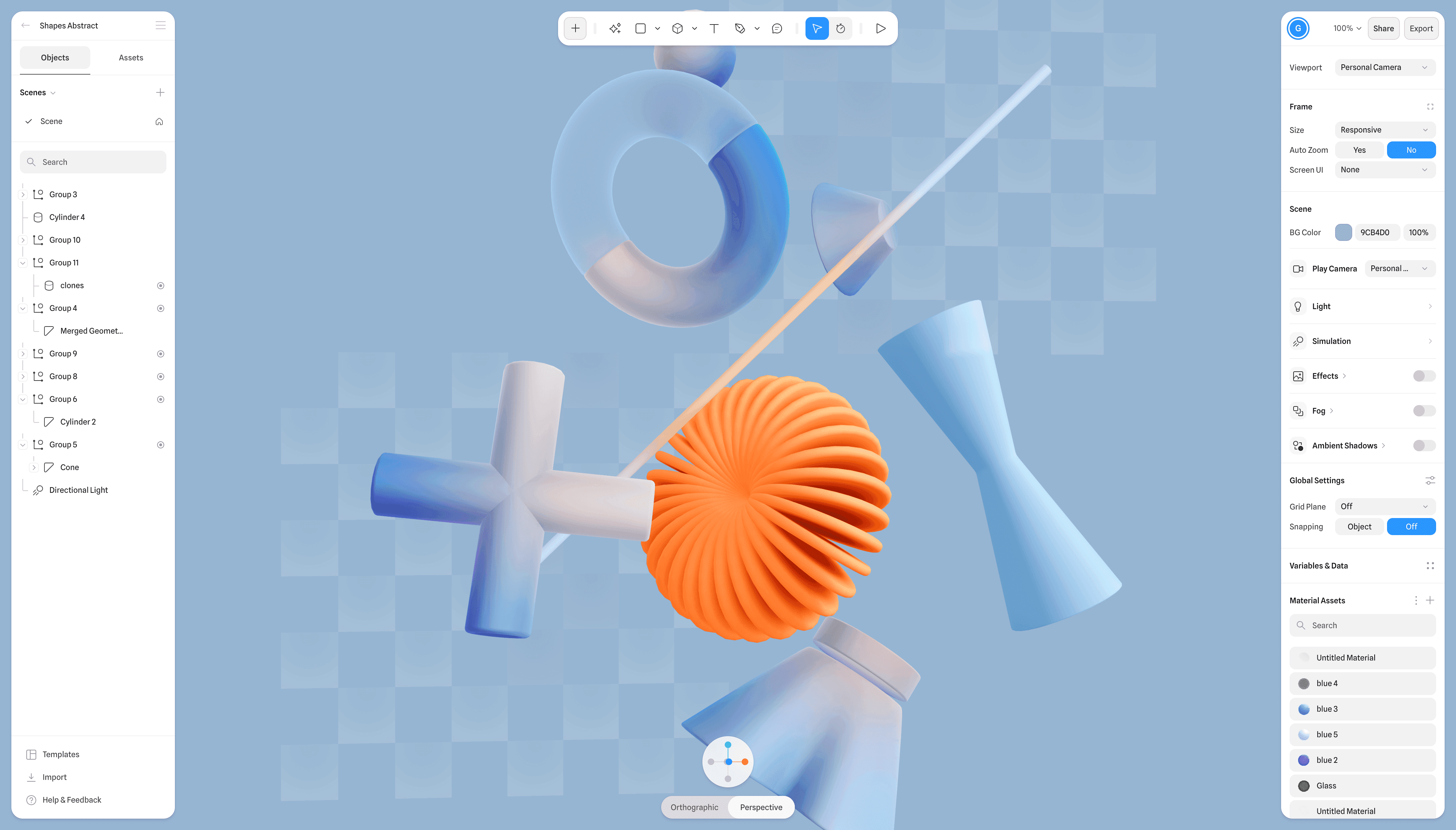
Spline has rebuilt its browser-based 3D editor from the ground up, placing AI agents, code, and a faster rendering engine at the center of the product. Spline V2 is not a small interface refresh. It changes how users can create, edit, automate, and run interactive 3D scenes.
The company announced Spline V2 on LinkedIn, describing it as a rebuild for the “agentic era.” Its official changelog lists a new interface, AI Agent Mode, Model Context Protocol access, WebGPU rendering, physically based materials, HDR workflows, and custom scripting.
Agents Can Control the Full 3D Scene
Spline V2’s AI chat agent can generate and edit scenes without flattening the result into a static asset. Objects, materials, lights, cameras, particle systems, paths, variables, animations, states, and event-driven interactions remain editable inside the editor.
The main agent-focused changes include:
- Deep scene editing, covering individual objects and scene-wide composition
- MCP access, allowing external agents such as Cursor and Claude Code to operate the editor through MCP tools
- Background generation for textures, images, and 3D models while other work continues
- Version history entries automatically created for every AI prompt
- Preview and Code tabs for testing scenes and adding browser-based interactions
This expands on the AI workflow introduced through Spline’s earlier Agent Mode, which could turn prompts into interactive 3D simulations, as Create With previously reported. V2 goes further by connecting those agent actions to the editor’s broader scene data and development surface.
A Faster Engine and More Realistic Materials
Under the interface, Spline has moved to a TSL-based WebGPU renderer by default, while retaining WebGL as a fallback. WebGPU enables features such as screen-space reflections and accelerates demanding graphics operations. The update also introduces GPU instancing for repeated geometry and materials, while boolean operations are described as roughly four times faster overall.
The visual pipeline now supports PBR materials, image-based lighting, additional texture-map channels, BRDF shading, glTF interchange, and HDR color. Designers can use HDR images as sky boxes, preserve their lighting while hiding the background, or generate a procedural physical sky. Other additions include planar mirror reflections, height fog, procedural dust and snow shading, vertex colors, and a GPU-accelerated hair system with lighting, shadows, wind, and clumping.
Custom code makes the editor more relevant to builders working beyond conventional 3D design. HTML and JavaScript can access scene data, modify objects, generate procedural content at runtime, or create game-like interactions layered over the 3D canvas. The AI agent can generate that code, while the Preview tab provides a dedicated environment for running it.
For small teams, the practical shift is that Spline V2 combines visual editing, agent-driven creation, and front-end scripting in one workspace. That could reduce handoffs between 3D designers and developers, although the announcement does not specify pricing, plan requirements, or limits for AI and MCP usage.
Frequently asked questions
What is Spline V2?
Spline V2 is a complete rebuild of Spline’s browser-based 3D editor. It adds an AI chat agent, MCP access for external agents, a WebGPU rendering engine, PBR and HDR workflows, and HTML/JavaScript scripting.
When is Spline V2 available?
Spline announced the release on August 20, 2026, and its changelog lists the update on August 21, 2026. The supplied announcement does not describe a staged rollout or specify whether any features are limited to particular plans.
Does Spline V2 require WebGPU?
No. WebGPU is the default rendering backend, but Spline provides WebGL as a fallback. Some capabilities, including screen-space reflections, are limited to WebGPU.
Sources
1 checkedHow we cover tool news: Create With's tool desk drafts these reports with AI from the sources listed above and checks them against those sources before publishing.




 ElevenLabs

 Glide

 Stripe