 Intercom
From Six Months of Engineering to Days of Integration
Freepik spent half a year attempting to build native AI support inside Salesforce. Three engineers. Countless iterations. No production deployment.
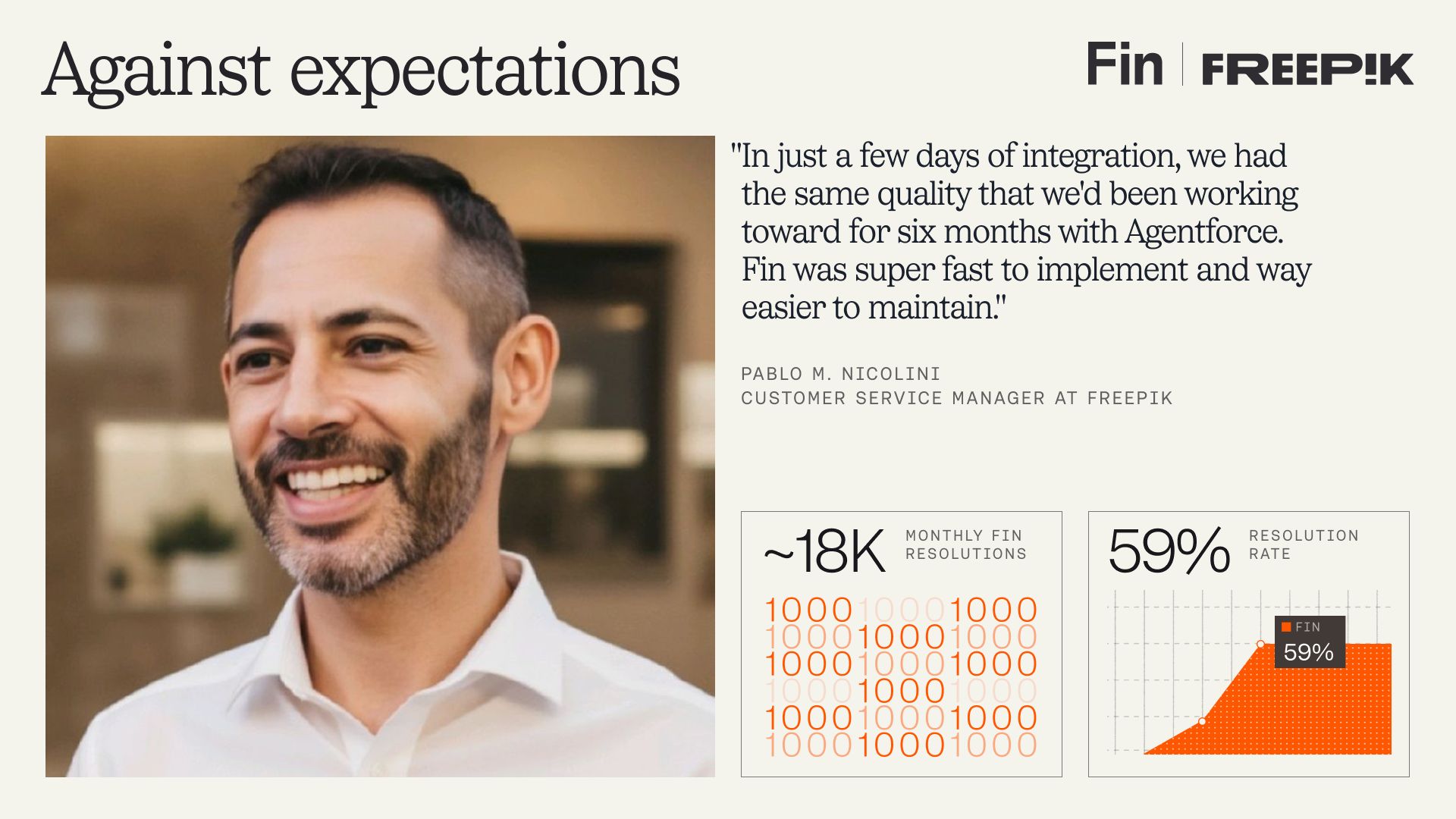
Then the digital asset platform tried Intercom's Fin for Salesforce and replicated the same quality in days, according to Pablo Maximiliano Nicolini, Freepik's Customer Service Manager. The company now resolves approximately 18,000 support tickets monthly through Fin, achieving a 59% resolution rate and automating 40% of all support interactions.
"In just a few days of integration, we had the same quality we'd been working toward for six months," Nicolini said in a LinkedIn post from Intercom. "It was super fast to implement and way easier to maintain."
The implementation required no changes to Freepik's existing Salesforce configuration. Fin integrated directly with their current setup, allowing the AI agent to handle customer queries within the CRM platform where support teams already work.
Why Internal AI Support Development Failed
Freepik's experience mirrors a common pattern: building production-ready AI support tools internally proves far more complex than anticipated. The company dedicated significant engineering resources to the project without reaching deployment.
Intercom's Fin for Salesforce sidesteps this challenge by providing a pre-built AI agent that works within existing CRM workflows. The tool leverages Intercom's customer service models, which the company recently opened to competitors, and builds on the Fin Apex 1.0 model designed specifically for support accuracy and speed.
The platform includes Intercom's observability features, allowing support leaders to monitor AI performance through metrics and quality controls. These capabilities became particularly relevant after Intercom shipped monitors for AI quality control as part of its broader push into AI management tools.
The Production Deployment Gap
The gap between AI prototypes and production systems remains a critical bottleneck for companies attempting to deploy support automation. Freepik's case demonstrates this clearly: despite months of development effort, the team never reached a stable deployment.
Fin for Salesforce addresses several technical challenges that complicate internal builds:
- Integration complexity: Connecting AI models to CRM systems while maintaining data security and proper access controls
- Model performance: Achieving consistent accuracy rates across diverse customer queries
- Maintenance overhead: Managing model updates, monitoring performance degradation, and handling edge cases
- Compliance requirements: Ensuring AI responses meet legal and brand standards
By handling these challenges at the platform level, Intercom allows companies to focus on configuration rather than infrastructure.
The 59% resolution rate Freepik achieved sits within the typical range for well-implemented AI support tools. The company's 40% full automation rate indicates significant deflection of routine queries from human agents, freeing support staff to handle more complex issues.
Intercom has positioned Fin as part of a broader AI agent platform, recently introducing developer tools including a CLI for Claude Code to streamline agent deployment. The Salesforce integration extends this approach to companies that have standardized on Salesforce as their customer relationship management system.
The case study underscores a shift in enterprise AI adoption: rather than building custom solutions from scratch, companies are increasingly opting for specialized platforms that deliver production-ready capabilities with minimal integration work. For Freepik, that meant trading six months of development time for a few days of configuration and a working system that handles nearly half of all support interactions.
Sources
1 checkedHow we cover tool news: Create With's tool desk drafts these reports with AI from the sources listed above and checks them against those sources before publishing.

 Stripe

 Airtable
 Adalo

 Squarespace
 ElevenLabs