 Bubble
Bubble Upgrades AI Agent With Claude Opus 4.7 After Early Testing Partnership
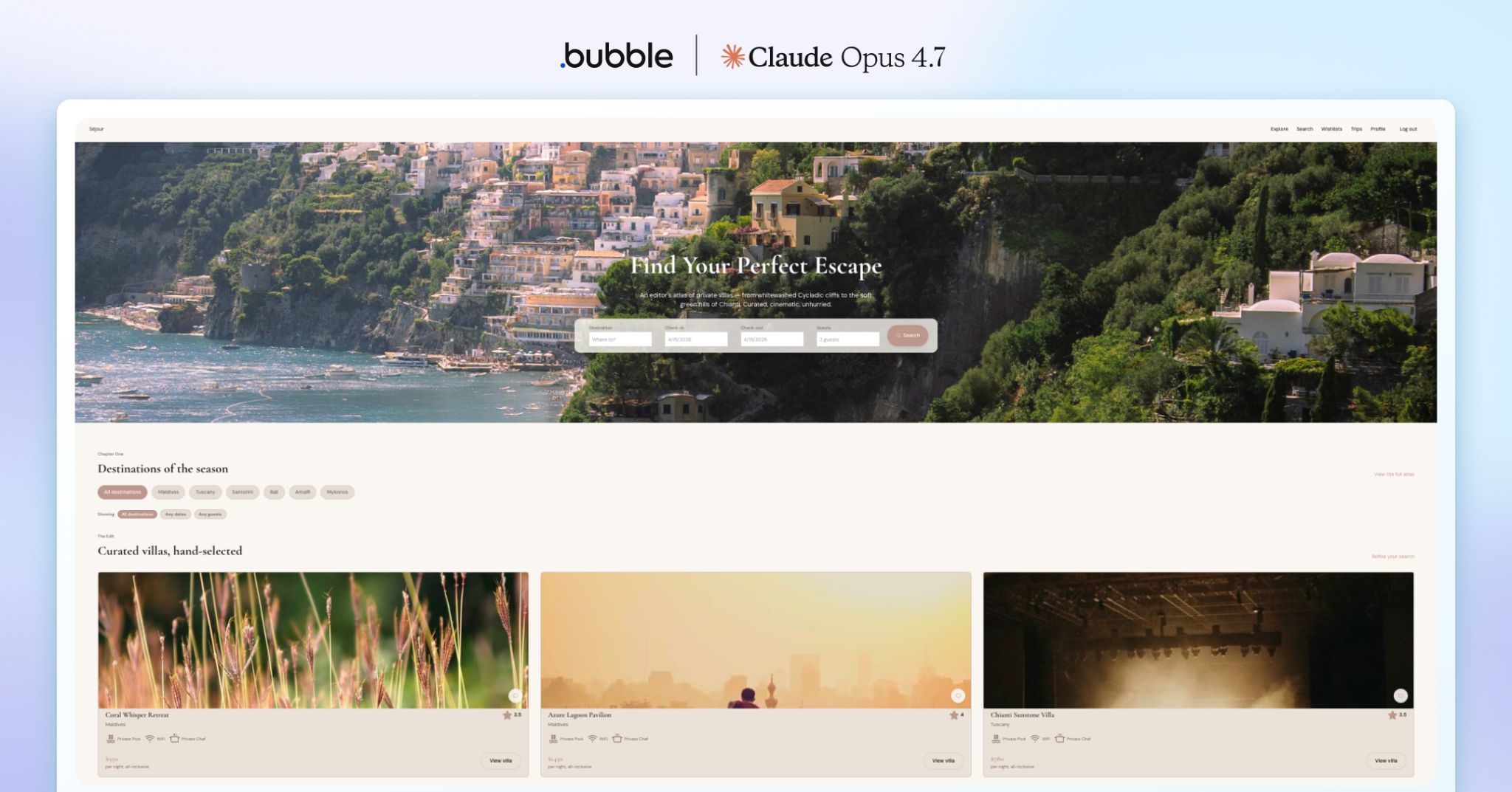
Bubble has integrated Claude Opus 4.7 into its AI Agent following an early testing partnership with Anthropic. The no-code platform announced on LinkedIn that the upgrade delivers a 5-10% improvement in cross-page visual consistency for new app generations.
The update represents Bubble's continued investment in AI-assisted development, building on infrastructure and agent improvements rolled out earlier this year. By participating in Anthropic's early testing program, Bubble was able to provide technical feedback that helped shape the final release.
What the Visual Consistency Improvement Means
The 5-10% gain in cross-page visual consistency addresses a common challenge in AI-generated applications: maintaining coherent design language across multiple pages and workflows. When Bubble's AI Agent generates multi-page applications, the improved model better preserves styling decisions, component patterns, and layout conventions from one page to the next.
This matters for builders who use the AI Agent to scaffold entire applications rather than individual pages. Inconsistent spacing, typography, or color usage across pages typically requires manual cleanup, and even a small percentage improvement can translate to meaningful time savings at scale.
The upgrade applies to all new app generations created with Bubble AI. Existing applications won't see retroactive changes, but builders can regenerate pages or start new projects to take advantage of the improved model.
Early Access and Technical Feedback
Bubble's participation in Anthropic's early testing program gave the company a window to evaluate Claude Opus 4.7 before public release. The platform used this period to assess how the model handled visual design generation specifically, focusing on consistency metrics that matter to no-code builders.
By sharing technical feedback with Anthropic during this phase, Bubble helped inform refinements to the model's behavior in design-heavy contexts. This kind of partnership between AI providers and platform companies is becoming more common as generative models move from general-purpose chat to specialized application domains.
Other no-code platforms have taken different approaches to AI integration. Lovable and v0 generate code directly, while Bubble's visual workflow preserves the platform's core abstraction layer, an approach co-CEO Josh Haas has defended as better suited for non-technical builders.
Broader Context for Bubble's AI Strategy
The Claude Opus 4.7 integration continues Bubble's methodical rollout of AI features. The company introduced its AI Agent to existing apps in April 2026, expanded mobile plugin support, and shipped backend infrastructure upgrades, as co-founder Emmanuel Straschnov detailed in a recent AMA.
Bubble has also highlighted community-built tools that extend AI capabilities on the platform. Buildprint recently launched an AI agent workflow with automated testing and context retention, showing how third-party developers are building on Bubble's AI foundation.
The visual consistency improvement addresses one of the persistent friction points in AI-assisted design: ensuring generated output looks intentional rather than assembled. As models like Claude, ChatGPT, and Gemini improve at understanding design systems, platforms that integrate them early stand to benefit from tighter feedback loops with model developers.
Bubble users can access Claude Opus 4.7 through the AI Agent interface when starting new app generation workflows. The company has not disclosed whether it plans to offer model selection or version pinning for builders who want more control over which AI backend powers their projects.
Sources
1 checkedHow we cover tool news: Create With's tool desk drafts these reports with AI from the sources listed above and checks them against those sources before publishing.






 ElevenLabs

 Glide

 Stripe